
Biomacromolecular phase separation and Polymer Physics research group
Research Focus
We use computational and theoretical tools to: i) understand the rich polymer physics of biomolecular condensates, ii) uncover the role of phase separation of proteins/RNA/DNA on biochemical reactions, iii) Applications of biomolecular condensates. In the future, we also aim to engineer better enzymes for efficient biofuel production using computational tools.
Engineering synthetic cell-free pyrenoids for efficient carbon fixation
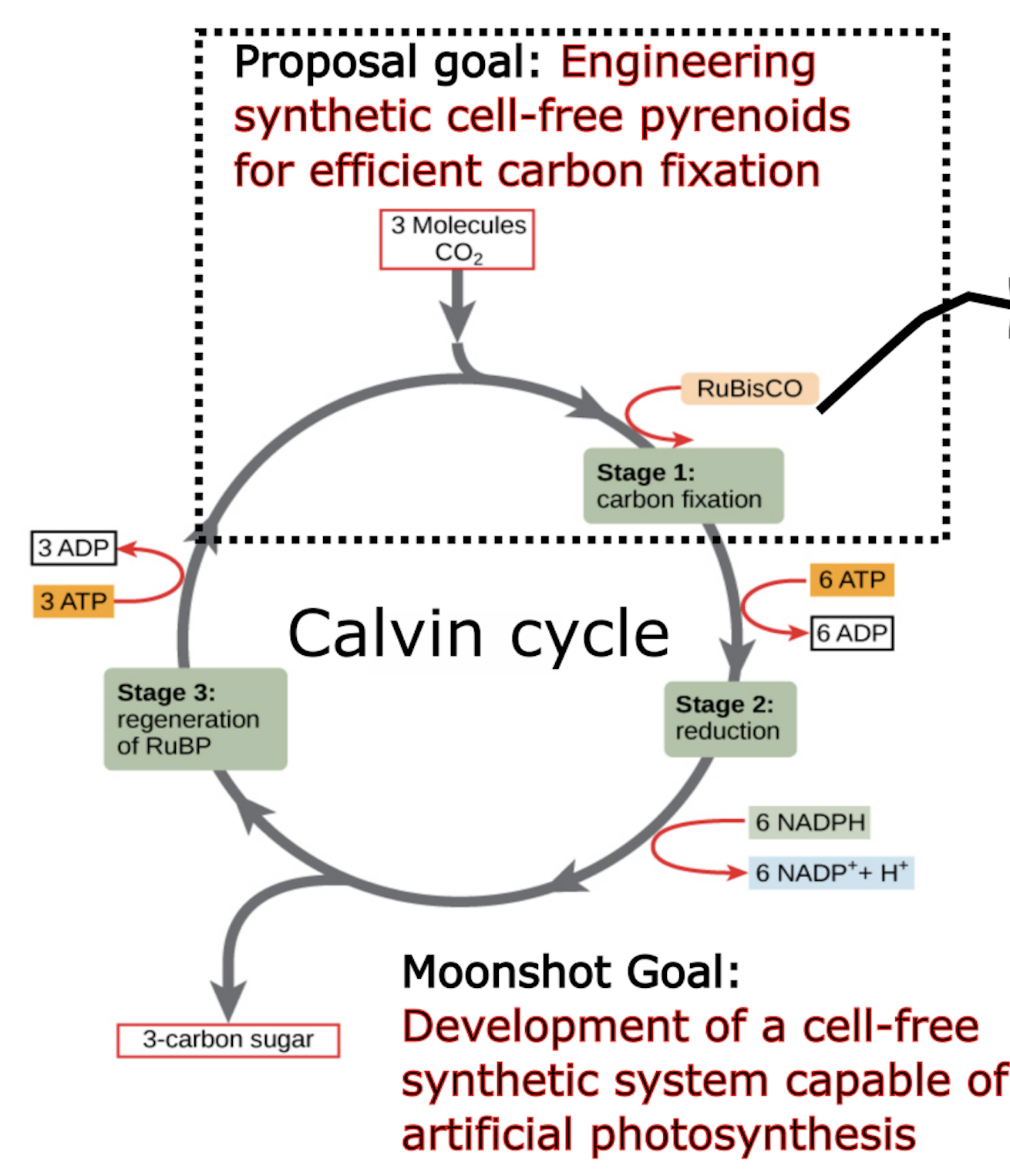
Almost one-half of all the global carbon capture takes place in the oceans, and most of this assimilation is attributed to eukaryotic algae. Eukaryotic algae perform photosynthetic carbon assimilation via the CO₂-fixing enzyme Ribulose-1,5-bisphosphate carboxylase/oxygenase (Rubisco), which is frequently clustered within a non-membrane-bound microcompartment called the pyrenoid. Pyrenoids are phase-separated compartments of the enzyme Rubisco and its scaffold EPYC1 protein.
In this project, we aim to use computer simulations and synthetic biology tools to engineer minimal pyrenoids capable of capturing inorganic carbon dioxide and turning it into useful organic precursors. By obtaining design rules for the construction of a minimal pyrenoid and its demonstration, we can create a prototype device which can be engineered to capture CO₂ effectively, and convert it to a useful product.
Coupling of phase separation to biochemical reactions
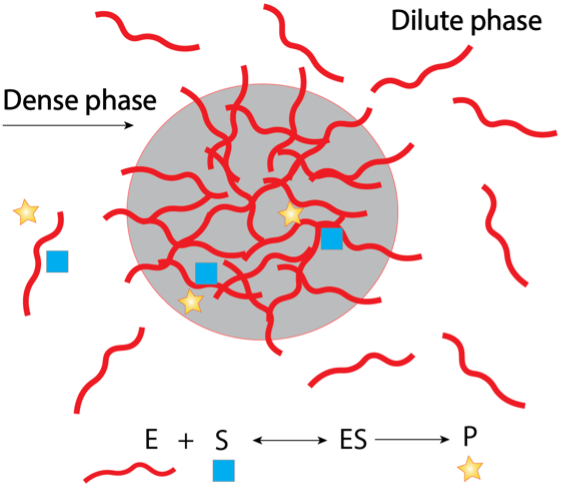
Phase separation is ubiquitous in chemical engineering, with many important processes such as liquid-liquid extraction employing phase equilibria to separate different components. Recent discoveries of phase separation of biomacromolecules to compartmentalize the intracellular environment have upended the traditional understanding of cellular compartmentalization mediated by membranes. Phase separation of proteins and nucleic acids has been shown to result in the formation of many important intracellular compartments, such as stress granules, p-bodies, nucleolus etc., known as biomolecular condensates.
Phase separation results in coexisting dense and dilute phases which can modulate biochemical reactions in the distinct phases. Important biochemical reactions such as transcription and enzyme-catalyzed reactions are affected by phase separation. Dysfunctional phase separation has been implicated in various diseases, including cancers, and there are substantial efforts to find drugs to target condensates. Tantalizingly, phase separation has been implicated in both the acceleration and attenuation of reactions.
The goal of lab’s research is to understand how phase separation affects different classes of biochemical reactions and to uncover physicochemical principles that lead to acceleration vs. attenuation of reactions.